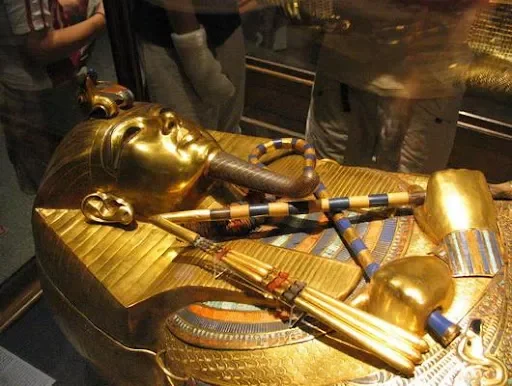
The Boy Behind the Gold
Tutankhamun became pharaoh at nine years old and was dead by eighteen. He ruled for less than a decade, during a period Egypt was quietly trying to forget — his father, Akhenaten, had upended the country's religion, and young Tut spent his short reign putting things back as they were. He was not a great conqueror. He was not remembered with particular warmth by ancient Egyptians.
What made him immortal was an accident of geography. His tomb was small, hastily prepared, and hidden beneath a layer of workmen's rubble in the Valley of the Kings. For three thousand years, tomb robbers walked directly over him without realising. By the time Howard Carter found the entrance in November 1922, every other royal tomb in the valley had been emptied. Tut's was the only one that still held everything.
That is why his name carries the weight it does. Not because of who he was, but because of what survived with him — and what that survival can tell us about a world we would otherwise know only in fragments.

Two Places, One Story
To understand Tutankhamun properly, you need to visit both his resting place and his treasure. They are 650 kilometres apart, and each tells a different half of the same story.
The Tomb (KV62) — Valley of the Kings, Luxor
This is where he still lies. His mummified body remains inside a climate-controlled glass case in the burial chamber — the only pharaoh in the entire valley who never left home. The tomb itself is modest by royal standards: four small rooms, painted walls, a quartzite sarcophagus. It takes about ten minutes to walk through. Those ten minutes tend to stay with people for years.

The Grand Egyptian Museum (GEM) — Giza
After the museum's full opening in late 2025, all of Tutankhamun's objects are now displayed together for the first time in history — not split between basements and side galleries as they were for decades at the old Egyptian Museum in Tahrir Square. The Tutankhamun Galleries occupy roughly 7,000 square metres. You walk through them more or less the way Carter did: starting with the antechamber clutter — the chariots, the folding camp bed, the alabaster jars — and ending in front of the gold mask.
The mask is smaller than photographs suggest — about 54 centimetres tall, 11 kilos of solid gold. The feeling it produces, when it arrives, is quieter than you expect. It is the realisation that someone made this with their hands.
— Eleganza Travel
Planning the Journey
A satisfying Tutankhamun-centred journey through Egypt takes seven to ten days. Less than that and you are rushing; more, and you are padding. A rhythm that consistently works well for European travellers:
- Land in Cairo. Spend two days at the Grand Egyptian Museum and the Pyramids of Giza next door — the two sites are now physically connected, which means you can pair the gold of Tutankhamun with the architecture of his ancestors in a single afternoon.
- Fly to Luxor (one hour — far easier than the overnight train, despite what older guidebooks suggest). Spend two days in the Valley of the Kings, Karnak, and Hatshepsut's temple. KV62 is the obvious pilgrimage, but don't overlook the nearby tomb of Seti I — the most beautifully painted in the valley, and consistently missed.
- Add a Nile cruise from Luxor to Aswan if you have the days. Three or four nights on the river is the calmest, most contemplative way to travel through Egypt, ending at the temples of Edfu, Kom Ombo, and Philae.
- Return to Cairo for a final evening. Many travellers find a second visit to the GEM, after seeing the actual tomb in Luxor, lands very differently.

What Most Travel Guides Won't Tell You
The curse of Tutankhamun is a story sold by 1920s newspapers, not by Egyptologists. Howard Carter, who opened the tomb, lived another seventeen years. The myth makes for atmosphere at dinner; it should not shape your itinerary.
Photography inside KV62 is permitted with an additional photo pass — check current pricing at the Valley ticketing office on the day, as it changes seasonally. The best light in the entire Valley of the Kings falls between 7 and 9 in the morning, before the sun flattens everything into white glare. Go early. Wear closed shoes — the rocks are loose underfoot. Carry more water than you think you need.
At the GEM, decide in advance whether your day belongs to Tutankhamun or to the wider collection. The museum is enormous — a full circuit takes five to six hours — and trying to do both in one visit is how people end up exhausted and retain nothing. The Tutankhamun Galleries alone deserve three hours minimum.

When to Go
October to April is the comfortable window for the Valley of the Kings. November and February are the sweet spot — warm days, cool evenings, manageable crowds. Avoid late July and August in Luxor unless you genuinely welcome 45°C heat at noon.
The Grand Egyptian Museum is fully air-conditioned and open year-round, which makes it a valuable refuge even in the summer months. If you can only travel in July or August, consider reversing the itinerary — GEM and Cairo first, then a shorter, early-morning visit to Luxor before the heat peaks.

People come to Egypt expecting spectacle, and Egypt delivers. But the moment most travellers carry home is smaller than any of that — standing in a painted room in a hot valley, looking at a young man who died three thousand years ago and was found again because someone refused to give up looking. That story is waiting for you. In 2026, it is easier to reach than it has ever been.
Frequently Asked Questions
Plan this journey with Eleganza
Share your dates, pace, and must-see places. Our travel consultants will shape a private itinerary around the way you want to experience Egypt and beyond.